Pet Fish Food: The Complete Guide to Choosing, Feeding & Storing It Right
Introduction
You’re standing in the pet store, staring at an entire wall of fish food.
Flakes. Pellets. Freeze-dried bloodworms. Live brine shrimp. Little colored wafers. Your fish is back home, waiting, and you’re supposed to know what goes in its mouth. Except you don’t. And honestly? Most people don’t either when they start.
Here’s what I’ve learned after keeping fish for years: feeding isn’t the simplest part of fishkeeping. It’s actually where most people mess up. Not because they’re careless, but because nobody really explains why the right food matters so much.
Wrong food type. Wrong amount. Wrong frequency. Pick all three, and your fish doesn’t just get malnourished—you get cloudy water, algae blooms, and dead fish that people assume died from disease. They didn’t. They died because their owner was accidentally poisoning them with overfeeding.
This guide covers what your fish actually needs to eat, why it matters, and how to avoid the mistakes that tank most aquariums. If you take one thing from this: stop assuming fish feeding is simple. It isn’t.
Quick Answer: What Do Fish Actually Eat?
Most pet fish food comes down to pellets or flakes as your daily staple, with occasional treats mixed in. Your fish needs protein, fat, carbs, vitamins, and minerals—all in the right proportions. Which exact food? That depends on whether your fish is a carnivore, herbivore, or omnivore. And probably on how picky it is.
One rule: feed only what disappears in 2–5 minutes. Anything left over becomes toxic sludge on your tank floor.
The Main Types of Pet Fish Food (Comparison)
Not all fish food pet options do the same job. Each has different pros, shelf lives, and drawbacks. Here’s what you’re actually choosing between:
| Food Type | Best For | Shelf Life | The Good | The Bad | How Often |
| Flakes | Small tropical fish, tetras, guppies | 6-12 months | Cheap, portable, easy to portion | Lose 90% vitamins in 30 seconds underwater, cloud water fast | Supplement only |
| Pellets | Most fish (if their mouth fits) | 12-18 months | Better vitamin retention, less tank mess | Can overfeed bottom feeders if sinking type | Daily staple |
| Freeze-Dried | Picky eaters, small fish, treats | 2-3 years | High protein, no thawing, long shelf life | Incomplete nutrition, expensive | 1-2x weekly |
| Frozen | Carnivorous fish, marine species | 6-12 months (frozen) | Nutrient-dense, fish go crazy for it | Requires thawing, spoils quickly, messy | 2-3x weekly |
| Live Food | Sick fish, breeding conditioning | Days-weeks | Triggers natural hunting, highest palatability | Introduces parasites, makes healthy fish picky | Emergency only |
Let me break down what actually happens when you feed each type.
Flake Food: The Problem Child
Fish flakes are thin, light, float on the surface. They’re everywhere because they’re cheap and easy. People buy them, sprinkle some in, feel like they’ve fed their fish. Done.
Except here’s what happens: flakes lose almost 90% of their vitamin content within 30 seconds in water. Thirty seconds. That “complete nutrition” label? It’s complete when dry. Once it hits water, it starts falling apart.
Also, flakes cloud water faster than other foods. And fish can eat them so quickly that you end up overfeeding without realizing it. The fish gulps down a huge amount in 20 seconds, and you think it’s still hungry because it’s looking at the surface.
That said, flakes aren’t useless. For smaller tropical fish like tetras or young guppies, flakes work fine as a supplement to something more substantial. Just don’t make them your fish’s only food source. You’ll have perpetually cloudy water and fish that aren’t thriving.
Pellet Food: The Smarter Choice
Food pellets are compact little cylinders. They come in two types—floating and sinking. Most serious aquarists use these as their staple for good reason.
Pellets hold their nutrition better than flakes. They’re denser, so less ends up decomposing on the bottom. Fish can’t inhale them in two seconds like they can flakes, which naturally helps with portion control.
Micro pellets work for smaller fish. Regular pellets for medium fish. Larger pellets for bigger species. The rule is simple: if your fish’s mouth can’t fit the pellet, it won’t eat it. Find the right size, and feeding becomes easier.
One thing people get wrong: sinking versus floating. If you have bottom feeders or fish prone to bloating (like goldfish), use sinking pellets. Floating pellets make fish swim up and gulp air, which can cause swim bladder problems. It sounds like a small detail. It’s not.
Freeze-Dried Food: Convenient But Incomplete
Freeze-dried bloodworms, brine shrimp, and krill are convenient and shelf-stable. Your fish will probably get excited about them.
But here’s the catch that matters: freeze-dried food isn’t nutritionally complete. It’s missing essential minerals and vitamins that pellets have. Use it as a treat 1–2 times per week, not as a staple.
Temperature matters with freeze-dried food too. Only feed it if your tank is at least 65°F. Colder than that, and your fish can’t digest it properly. The food just sits in their digestive system and rots. I’ve seen this cause serious problems.
Frozen Food: High Protein, High Maintenance
Frozen foods like krill and whole fish are protein-rich and more nutritious than freeze-dried options. Fish get genuinely excited about them in a way they don’t about pellets.
The downside? Thawing takes planning. You can’t just dump frozen cubes into the tank. Thaw them in a small cup of tank water first. And once thawed, they spoil quickly—within 30 minutes. If your fish doesn’t eat it, remove it.
Live Food: Use It Carefully
Live bloodworms and brine shrimp trigger natural hunting instincts. Your fish will act like it just won the lottery.
Here’s where it gets problematic. Feed live food to healthy fish regularly, and they become picky eaters. They’ll start rejecting balanced pellets because live food is more stimulating. Suddenly your fish only wants live food. Now you’re managing live cultures or buying it constantly.
Use live food strategically—for sick fish that won’t eat anything else, or for conditioning before breeding. Not as a regular diet.
One more thing: quarantine live food for 1–2 weeks before feeding. Live cultures carry parasites. One infected batch can crash an entire tank. It’s not worth skipping this step. I’ve seen it happen.
What Should Be in Your Fish’s Food? (Nutrition Breakdown)
Your fish doesn’t just need calories. They need specific nutrients in specific amounts. This is where ingredient lists actually matter.
Protein: The Most Important Component
Protein supports growth, tissue repair, immune function, and energy. How much your fish needs depends on what it eats in nature.
- Herbivorous fish: 35–45% protein
- Carnivorous fish: 40–55% protein
- Omnivorous fish: around 40–50% protein
But here’s what trips people up: not all protein is created equal. The protein needs to contain all essential amino acids. This is where quality actually matters.
Animal protein (fish meal, shrimp meal) provides complete amino acid profiles. Plant protein (soy, wheat) doesn’t. If soy is the first ingredient on your fish food label, your fish is missing key amino acids they can’t make themselves. They need those.
Check the ingredient list. If you see fish meal listed first, it’s usually a decent food. If you see grain listed first, keep looking.
Fat: Don’t Overlook This
Fat should be 15–25% of your fish’s diet. It provides energy, supports hormones, and insulates the body.
Fish oil is the best fat source. It has omega fatty acids that reduce inflammation and support immune function. Some cheap foods use soybean oil instead—it’s cheaper but doesn’t do the same job.
Here’s a detail most people miss: fat oxidizes over time. That food sitting in your cabinet for a year? The fats have gone rancid. Your fish gets less nutrition and potentially harmful oxidized oils.
Carbohydrates: Fuel for Swimming
Carbs should be 25–40% of omnivorous fish diets. Less than 20% for carnivores. Think about how much your fish swims during a day—that takes energy.
Peas, beans, and whole grains are good carb sources. The problem is that many cheap foods use grain fillers just to hold the pellet together, not for nutrition. You end up paying for filler instead of actual food.
Fiber: Often Neglected, Always Useful
Fiber should be less than 5%. It supports gut health, keeps digestion moving, and reduces intestinal inflammation.
Most quality foods get this right. Cheap foods often have fiber levels way too high because they’re using grain fillers to bulk up the pellet.
Vitamins and Minerals: The Invisible Essentials
Your fish needs vitamins A, C, D, E, and K. Without them, you’ll see weak immune systems and skeletal deformities—problems that are completely preventable.
Check the ingredient list specifically for these vitamins listed individually. If it just says “vitamin mix,” that’s a red flag. You don’t know what’s in there or in what amounts.
Minerals are listed as “ash” on the label. That’s basically calcium and phosphorus from bones, scales, and shells. It matters more than people think.
Here’s something most guides never mention: vitamin content degrades over time. That sealed container of fish food? After 6 months, it’s losing vitamins steadily. After a year, it’s significantly depleted. Keep food in airtight containers and replace it every 3–4 months. Yeah, really.
How to Choose the Right Food for Your Fish Species
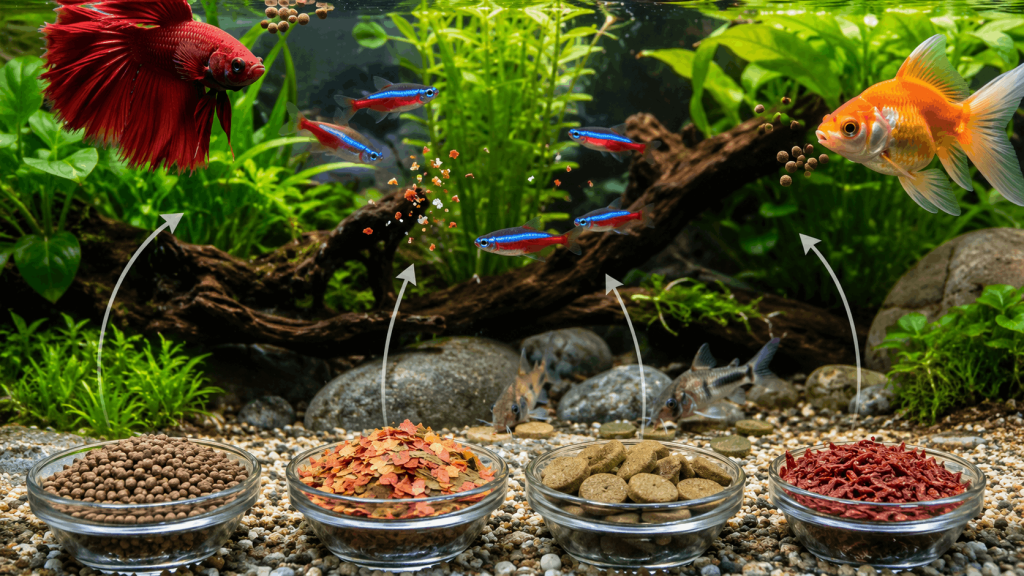
This is where theory hits reality. Generic advice doesn’t work because fish are incredibly different from each other.
Goldfish and Koi: The Gluttons
Goldfish and koi are omnivorous. They’ll eat pellets, flakes, vegetables—basically anything. The problem is they have no “off” switch for eating. Goldfish especially will eat until they literally explode.
Use sinking pellets for regular goldfish. Floating pellets for koi (they naturally feed at the surface). If your goldfish develops buoyancy issues, switch to sinking pellets exclusively. The floating type makes them gulp air, which makes the problem worse.
One practical detail: goldfish are messy eaters. They create more waste than smaller fish. You need slightly better filtration to handle a goldfish tank compared to tropical fish.
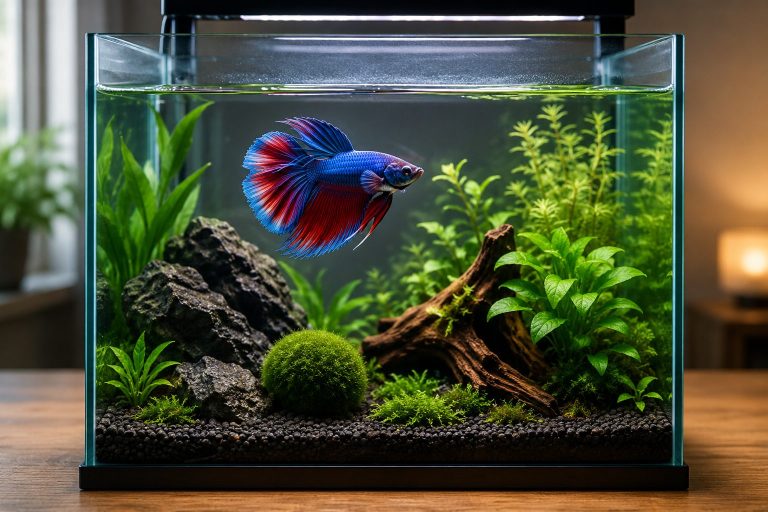
Bettas: The Carnivorous Picky Eaters
Bettas are carnivorous and need protein-heavy food—minimum 40–50%. Betta-specific pellets are formulated for their needs and sized appropriately for their small mouths.
Here’s something I’ve noticed: bettas can be really particular about food texture. One brand of pellets works great, but switch brands and suddenly your betta won’t touch them. Don’t assume the fish is sick or hungry. Try a different pellet type before concluding there’s a problem.
Bettas also appreciate variety. Rotate between betta pellets, freeze-dried bloodworms, and frozen brine shrimp. They’ll be more interested in eating, and you’ll cover nutritional gaps.
Tropical Community Fish (Tetras, Guppies, Mollies)
Most tropical fish are omnivorous and do well on quality micro pellets or flakes, supplemented with occasional freeze-dried treats.
Tetras are small. They need micro pellets or high-quality flakes. Guppies and mollies can handle slightly larger pellets. The key is matching food size to mouth size. Uneaten food just pollutes your tank.
Cichlids: The Protein Demanding Fish
Cichlids are mostly carnivorous (though some are omnivorous). They need high-protein diets and larger food pieces they can actually grab.
Cichlids also like feeding enrichment. They enjoy hunting-style feeding with frozen food or live (quarantined) options. It stimulates them mentally and keeps them active. A bored cichlid becomes an aggressive cichlid.
Larger cichlids like Oscars can technically eat whole feeder fish. But I’d recommend frozen options instead. It’s safer and more humane.
Saltwater & Marine Fish: Species-Specific Matters
Marine fish have wildly different nutritional needs. Some eat mainly zooplankton. Others eat algae. Some are carnivorous. Generic marine food doesn’t work for every species.
Research your specific fish before buying food. Don’t just assume “marine pellets” will work.
Bottom Feeders and Algae Eaters
Pleco, otocinclus, and other algae-eating species need specialized food. Algae wafers and vegetable-based pellets work well.
Here’s what confuses people: these fish won’t survive on just the algae in your tank. Most tanks don’t have enough algae. You need to supplement with algae wafers or vegetable-based foods.
Feeding by Life Stage
The nutrients fish need vary throughout different stages of their life. This gets overlooked but makes a real difference in how they develop.
Fry: The Frequent Feeders
Baby fish need smaller portions of more frequent meals. Sometimes 3–4 times daily. They also need higher protein for growth.
Newly hatched fry (really tiny ones) might need powdered food or liquid fry food initially. As they grow, transition to micro pellets or crushed regular pellets.
Growth during the juvenile stage is rapid. Proper nutrition at this stage determines adult size, coloration, and overall health. Don’t skimp here. It’s foundational.
Adult Fish: Settling Into Routine
Adult fish do well on 1–2 daily feedings. Their metabolism stabilizes. They don’t need constant feeding like juveniles.
This is where most people settle into a feeding routine. Consistency matters. Feed at roughly the same time each day. Fish have circadian rhythms—they’ll anticipate feeding time, which also creates bonding moments.
Senior or Sick Fish: Adjusting Expectations
Older fish eat less. Their metabolism slows down. They might have dental issues or digestion problems you can’t see.
If an older fish stops eating normal pellets, try live or frozen food. Sometimes a change in texture or food type re-triggers appetite. Sick fish also respond well to live food, which is why it’s worth keeping some on hand for emergencies.
How Often and How Much Should You Feed Your Fish?
This section is where I see the most confusion. People either way overfeed or starve their fish.
The 2-Minute Rule
Feed your fish only what they can eat in 2–5 minutes. That’s the whole rule. Start with less and add more if needed.
Why? Uneaten food decays on the bottom and produces ammonia. Ammonia poisons fish. It’s not about filling their stomachs—it’s about maintaining tank stability.
When you’re learning, underfeed slightly. That’s always the safer direction. You can always feed more tomorrow. You can’t remove food once it’s sunk.
Daily Feeding Schedule by Fish Type
| Fish Type | Feeding Frequency | Portion | Reality Check |
| Goldfish | 2-3x daily | 2-5 minute portion | These fish beg constantly. Ignore the begging. |
| Bettas | 1-2x daily | 2-3 minute portion | They can survive 3-7 days without food if needed. |
| Tropical fish | 1-2x daily | 2-5 minute portion | Once daily works fine in established tanks. |
| Cichlids | 1-2x daily | 3-5 minute portion | They appreciate hunting-style feeding variety. |
| Koi | 1x daily (cool), 2x (warm) | 5-10 minute portion | Don’t feed below 55°F; their metabolism shuts down. |
| Marine fish | 1-2x daily | 2-5 minute portion | Research your specific species; needs vary wildly. |
The Temperature Factor (Most People Forget This)
Here’s what catches people off guard: fish metabolism is temperature-dependent.
Below 55°F, fish basically can’t digest food. Their metabolism shuts down. If water temperature drops, reduce feeding or stop entirely. A goldfish in a cold pond in winter needs almost no food. It’ll live off stored energy.
Warm water (above 75°F)? Fish are more active and need more frequent feeding. Monitor your actual tank temperature and adjust.
Vacations and Feeding Breaks
Most healthy adult fish can go 7–10 days without food. Their metabolism slows, and they’ll survive on stored energy. Smaller or younger fish? Don’t push past 3–4 days.
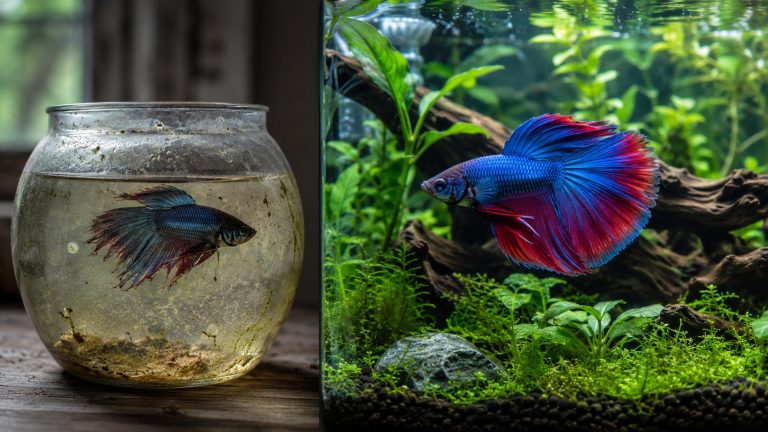
Here’s the mistake people make: they overfeed right before leaving town thinking they’re being kind. That’s the worst thing you can do. Uneaten food decays, water quality crashes, and fish stress out from poor conditions. You just made their situation worse.
If you’re leaving for a week, do a 25% water change, feed lightly the day before, and leave it. Don’t overfeed.
For longer trips, ask a friend to feed once every 3–4 days. Or use an automatic feeder, though I’m not a fan—they’re easy to overfill and they malfunction.
The Overfeeding Problem (And How to Avoid It)
Overfeeding is the #1 killer of aquarium fish. Not disease. Not poor genetics. Overfeeding.
I can’t stress this enough. It’s the most common cause of dead fish that people attribute to everything else.
Why Overfeeding Happens
Your fish looks up at you from the tank. It seems hungry. Excited. So you feed. And feed. And feed some more.
But here’s the reality: fish will eat until they literally burst. They have zero “I’m full” signal. In the wild, they don’t know when the next meal comes, so they eat whenever food appears. That instinct doesn’t disappear in a tank. It’s still there.
Overfeeding creates two cascading problems:
Problem 1: Uneaten food decays, producing ammonia (which is toxic). Your water becomes poisonous. Fish don’t die from starvation. They die from ammonia burns.
Problem 2: Fish consume too much, leading to constipation, bloating, swim bladder problems, and fatty liver disease.
Signs You’re Overfeeding
- Cloudy or murky water (even after water changes)
- Fish hanging at the bottom or top (stress or oxygen depletion)
- Algae blooms (excess nutrients fueling algae growth)
- White stringy poop hanging from fish (digestive distress)
- Bloated, swollen bellies (constipation or organ failure)
- Dead fish despite “good care” (usually ammonia poisoning)
See several of these? You’re likely overfeeding.
What to Do If You’ve Already Messed Up
If you see signs of overfeeding:
- Stop feeding immediately—skip 2–3 days of feeding while you fix the water
- Remove uneaten food with a net or siphon (all of it)
- Do a 25–50% water change to dilute ammonia buildup
- Increase aeration (add an air stone or turn up filter flow)
- Test water parameters if possible (ammonia, nitrite, nitrate)
- Resume very light feeding—much less than before
Recovery takes 1–2 weeks if the damage wasn’t severe. If fish are already showing signs of organ failure (extreme belly swelling, eye bulging, gasping), odds are poor.
Can Fish Eat Treats or Human Food?
Yes. But with real limitations.
Safe Occasional Treats (And I Mean Occasional)
- Blanched peas (remove the shell)—helps with constipation, omnivores love them
- Bloodworms (freeze-dried)—high protein, most fish go crazy for them
- Brine shrimp (live or frozen)—excellent for conditioning before breeding
- Lettuce (blanched, cut into small pieces)—herbivores enjoy this
- Cucumber slices (thin, boiled for a few minutes)—hydrating and gentle
- Zucchini (cooked until soft, cut into small pieces)—good for plant eaters
- Hard-boiled egg yolk—protein for fry or sick fish recovering appetite
- Watermelon (tiny pieces, no seeds)—hydrating, low calorie
- Squash (cooked, soft)—gentle on digestion, good for herbivores
The key: blanch vegetables to soften them. Small pieces only. Remove uneaten bits within 2 minutes. Offer treats sparingly—1–2 times per week, not daily.
Foods You Should Never Feed Your Fish
- Bread (causes bloating, buoyancy problems, doesn’t provide nutrition)
- Processed foods (chips, crackers, anything seasoned)
- Dairy (fish can’t digest lactose)
- Avocado (toxic)
- Chocolate (toxic)
- Raw meat (introduces bacteria)
- Anything with salt, oil, or seasoning
I’ve seen fish owners give their fish bread or chips thinking they’re being nice. That’s a slow death. Stick to the safe list.
Introducing New Food Types
If you’re trying a new food brand or type, introduce it gradually over 1–2 weeks. Mix it with their current food, slowly increasing the ratio.
Sudden diet changes cause digestive upset and stress. Fish can take time to accept new foods. Be patient.
Storing Fish Food the Right Way
You buy premium food, but if you store it wrong, you’re wasting money and nutrition.
How Long Does Food Actually Last?
- Flakes: 6–12 months sealed, 2–3 weeks opened
- Pellets: 12–18 months sealed, 1–2 months opened
- Freeze-dried: 2–3 years sealed, 3–4 weeks opened
- Frozen: 6–12 months in freezer, use immediately after thawing
The clock starts the moment you open the container. Vitamin degradation happens fast once the food hits air and moisture.
How to Tell If Food Is Spoiled
- Rancid or musty smell (oils oxidizing)
- Visible mold or discoloration (contamination)
- Clumping (moisture got in there)
- Stale smell (age and oxidation)
If any of these apply, throw it away. Spoiled food won’t provide nutrition and might harbor harmful bacteria.
Storage Best Practices
- Use an airtight container—mason jars or vacuum-seal bags work great
- Store in a cool, dark place—not above the aquarium (heat kills vitamins)
- Don’t store in a humid kitchen (moisture ruins pellets)
- Label with the purchase date—helps you rotate stock
- Keep frozen food in the freezer—only thaw what you need
- Don’t buy more than 3–4 months of food at a time—bulk buying doesn’t work if it spoils
The big mistake: people buy huge containers to save money, then the food spoils before they use it. A smaller container you replace frequently is better than a bulk buy that loses nutritional value.
Common Pet Fish Feeding Mistakes to Avoid
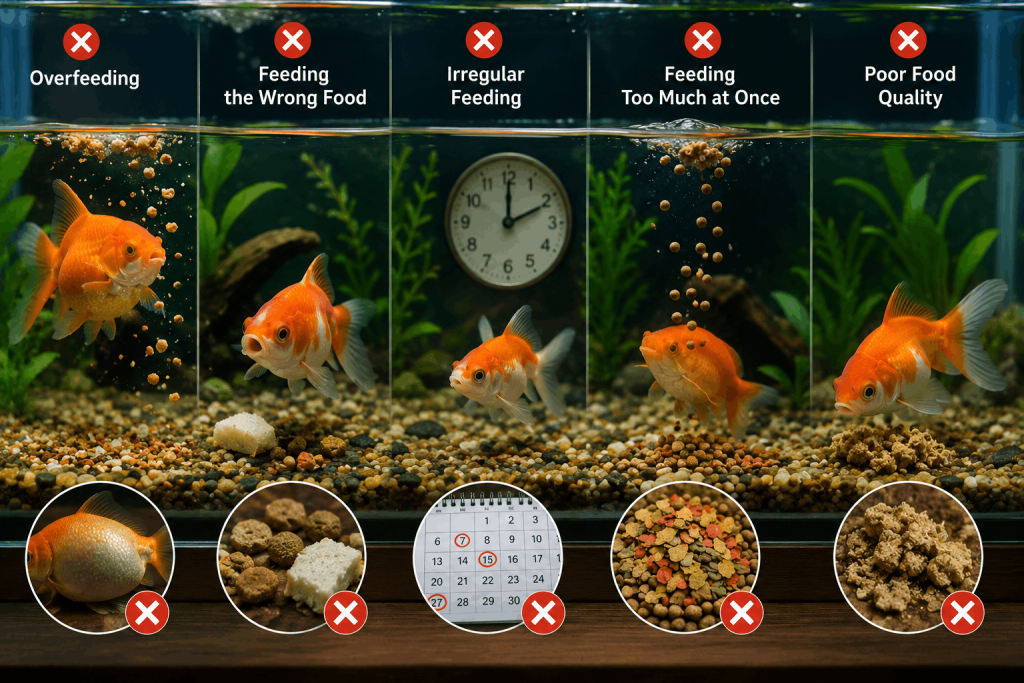
Learning from someone else’s mistakes is often faster than making them all on your own. . Here’s what catches people most often.
Feeding the wrong food type for your species. Not all fish do well on flakes. Plecos need sinking pellets or algae wafers. Cichlids need appropriately sized pellets. Match food to species—this is basic but often overlooked.
Relying on a single food source. Fish in the wild eat varied diets. Feed a mix of pellets, occasional freeze-dried treats, and vegetables. Variety prevents nutritional gaps and keeps fish interested in eating.
Feeding on a fixed schedule regardless of water temperature. If your tank temperature drops, feed less. Fish can’t digest food in cold water. Adjust based on actual conditions.
Ignoring expiration dates and age of the food. Old food is basically empty calories. That 2-year-old container under the sink has lost most of its vitamins. Replace regularly.
Not quarantining live food. One parasite-infected feeder fish can tank an entire aquarium. Always quarantine live food for 1–2 weeks before feeding.
Overfeeding a newly cycled tank. New aquariums have not yet developed a stable nitrogen cycle, making them especially vulnerable to ammonia spikes caused by excess food. Fish in these tanks are far less able to tolerate the resulting decline in water quality.Start lightly and wait until the cycle establishes itself.
Assuming picky eating means hunger. Sometimes fish refuse food because it’s the wrong type, wrong size, or water conditions are poor. It’s rarely actual starvation. Investigate before feeding more.
Feeding fry the same food as adults. Fry need powder or liquid fry food initially. Adult pellets are too large. As they grow, transition slowly to regular food.
Buying Guide: Budget vs. Premium Fish Food
Not all fish food is equally effective, but you don’t always need the most expensive option either.
When Budget Food Is Actually Fine
Budget food works for hardy omnivorous fish (goldfish, guppies, mollies) if you’re careful about portions and storage. The nutritional profile is adequate, though not optimal.
The catch: budget food has lower vitamin retention and shorter shelf life. You’ll need to replace it more frequently, which sometimes negates the savings. Do the math.
Solid budget brands: Tetra (their basic lines), Aqueon, and API work reasonably well. Not perfect, but functional.
When It’s Worth Paying More
Premium food is worth the investment for:
- Carnivorous species (bettas, cichlids) that require higher protein
- Finicky eaters that demand higher palatability
- Show fish or breeding fish where coloration and development actually matter
- Senior or sick fish needing concentrated nutrition
Brands like Omega One, New Life Spectrum, and Hikari cost more because their ingredient profiles are legitimately better. You’ll see healthier fish, better coloration, and less water pollution.
Quick Checklist Before You Buy
- Species-appropriate? (Right protein level for your fish type)
- Contains whole protein sources? (Fish meal, not soy-based)
- Includes multiple vitamins? (A, C, D, E, K listed individually)
- Appropriate size for your fish’s mouth? (Pellets fit comfortably)
- Fresh? (Check manufacturing date)
- Stored properly in-store? (Not sitting under hot lights)
- Within your budget? (You can afford to replace it every 3–4 months)
If it checks all boxes, you’ve found a winner.
Frequently Asked Questions
What is the best food for pet fish?
There’s no universal “best.” It depends on your species. That said, quality pellets (Omega One, Hikari, New Life Spectrum) consistently outperform cheaper options. Better ingredient profiles, higher vitamin retention, less waste. Pair them with occasional freeze-dried treats for variety. That formula works for most fish.
How often should I feed my fish?
Most adult fish do well on 1–2 daily feedings. Young fish need 3–4 times daily. Feed only what they can eat in 2–5 minutes. Temperature matters—cold water (below 55°F) means less frequent feeding or none at all. When in doubt, underfeed. It’s harder to recover from overfeeding than underfeeding.
Can fish go without food while I’m on vacation?
Yes. Healthy adult fish can skip food for 7–10 days without harm. Actually safer than having someone overfeed while you’re gone. For longer trips, ask a friend to feed small amounts every 3–4 days. Never leave an automatic feeder unsupervised. They encourage overfeeding every single time.
Is it bad to feed fish flakes every day?
Not catastrophic, but not ideal. Flakes lose vitamins quickly and cloud water faster than pellets. Use flakes as a supplement, not a staple. Pellets are the better daily choice for most fish.
Do fish need live food to stay healthy?
No. Live food is optional enrichment, not a nutritional necessity. Quality pellets provide complete nutrition. Live food is useful for conditioning before breeding or re-stimulating appetite in picky eaters. It’s a tool, not a requirement.
Can fish overeat and die?
Yes, absolutely. Overfeeding causes constipation, swim bladder problems, fatty liver disease, and ammonia poisoning from uneaten food. Fish have no “stop eating” signal. You’re responsible for portion control. This is probably the #1 cause of preventable fish deaths.
How do I know if my fish food has expired?
Smell it. Rancid or musty odors mean it’s degraded. Check for mold, discoloration, or clumping. Look at the manufacturing date if available. If it smells off, throw it out. It won’t provide proper nutrition.
What human foods can fish eat safely?
Blanched vegetables (peas, zucchini, lettuce), freeze-dried bloodworms, and hard-boiled egg yolk. Avoid bread, dairy, processed foods, and anything seasoned. Always remove uneaten bits within 2 minutes.
Conclusion
Here’s the honest truth: feeding isn’t complicated. It just requires thinking beyond the flake container.
Match food to your fish’s species and life stage. Feed small amounts frequently rather than large amounts rarely. Store food properly so it doesn’t lose nutritional value. And remember this most important rule: uneaten food is poison.
Your fish will always look hungry. They’ll always beg at the glass. That’s instinct, not reality. Err on the side of underfeeding. Your fish won’t starve. But overfeeding? That’ll kill them.
Get feeding right, and everything else becomes easier. Water stays cleaner. Fish develop proper colors. They live longer. You stop wondering why your tank keeps crashing.
Start with quality pellets as your staple. Add variety with treats. Adjust based on actual temperature and fish behavior. That’s genuinely all you need.