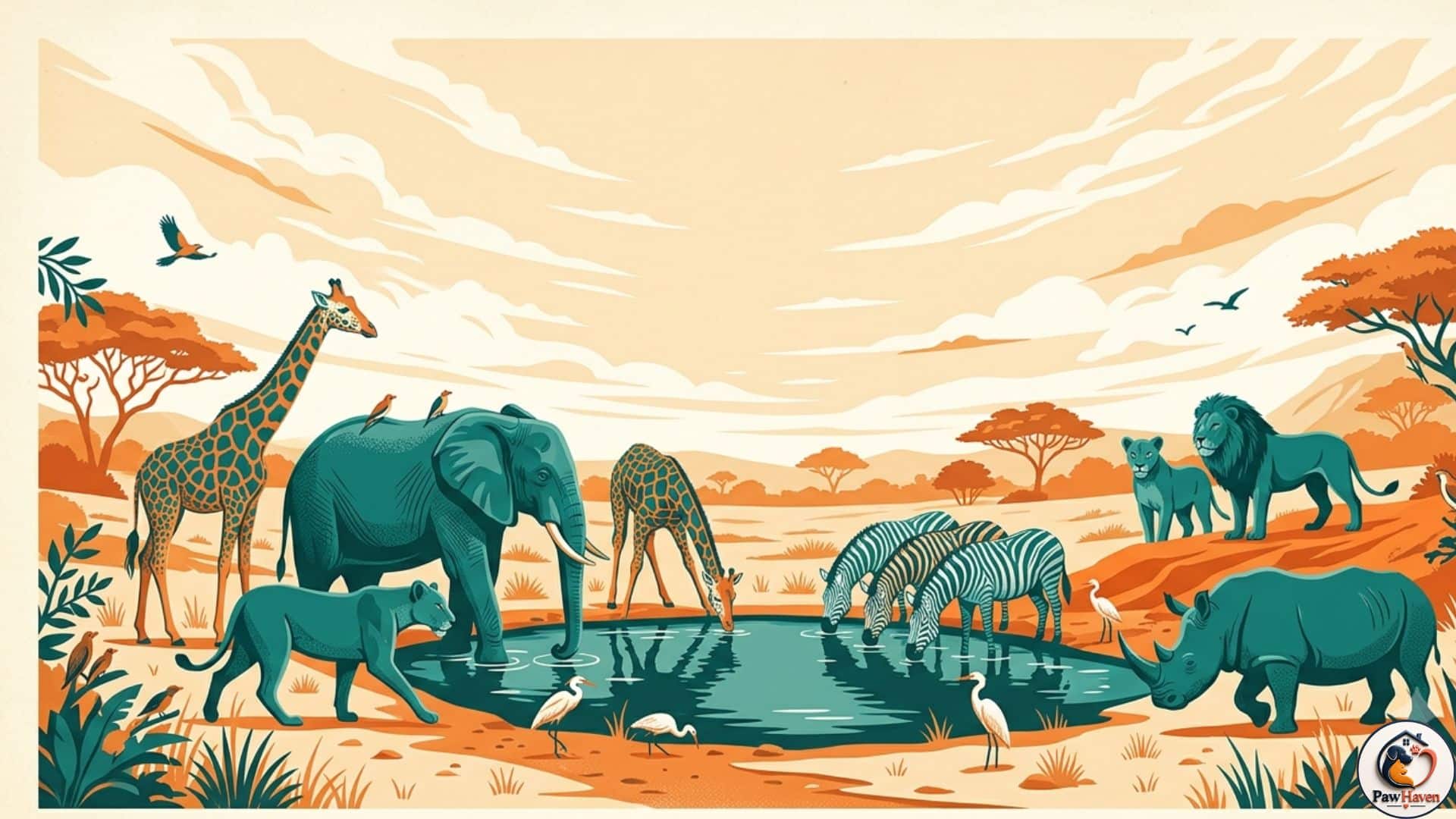
Wild Animals
There’s something that happens the first time you watch a wildlife documentary and see a lion pause, scan the horizon, and vanish into tall grass with zero wasted movement. You realize, almost immediately, that no zoo enclosure, no wildlife park fence, no book on a shelf fully captures what wild animals actually are. They’re not just creatures. They’re entire systems of survival.
This guide covers what wild animals are, where they live, how they eat and adapt, which species are under the most pressure right now, and what any ordinary person can realistically do to help.
Quick Answer: Wild animals are non-domesticated species that live, feed, and reproduce in natural habitats without human dependency. They span every major animal group from mammals and birds to reptiles, amphibians, fish, and invertebrates, and are found on every continent. Their survival is directly tied to ecosystem health, which in turn supports human life through clean air, water, and food systems.
What Are Wild Animals?
Most people think they know what a wild animal is until they try to define it precisely. Here’s where it gets interesting.
Definition of Wild Animals
A wild animal is any animal that hasn’t been domesticated and maintains its survival independent of humans. That doesn’t just mean lions and tigers. Sparrows, foxes, hedgehogs, bees, salmon, all wild. The key distinction isn’t size or danger level. It’s a dependency. Wild animals didn’t adapt alongside human agriculture over thousands of years, the way dogs, cats, and horses did.
Why Are Wild Animals Important?
Here’s what most wildlife articles skip over: wild animals aren’t just beautiful or fascinating. They are structural components of ecosystems. Remove one keystone species and entire food webs collapse. The reintroduction of wolves to Yellowstone National Park in 1995 is the clearest modern example. Wolves reduced elk overgrazing, which allowed riverbank vegetation to recover, which stabilized riverbanks, and changed the physical path of rivers. One predator. Measurable landscape changes within years.
That’s what wildlife conservation actually protects not just animals, but ecological relationships.
Key Characteristics of Wild Animals
Wild animals share a few traits regardless of species:
- Self-sufficient feeding and hunting behaviors developed without human involvement
- Instincts that prioritize survival, reproduction, and territorial defense
- Seasonal behaviors, including migration, hibernation, and breeding, are tied to environmental cues
- Physical and behavioral adaptations specific to their native habitat
They’re also, in most cases, genuinely afraid of humans, which is healthy and appropriate. An animal that loses that fear is usually one in trouble.
How Wild Animals Differ from Pets and Domestic Animals
Domestication is a multi-thousand-year genetic process, not just a change in environment. Dogs have been selectively bred for approximately 15,000 years to read human social cues. Wild animals haven’t. Even animals raised from infancy by humans retain wild behavioral instincts that typically become a serious safety problem once the animal matures.
Types of Wild Animals
The animal kingdom is enormous. Most people think of megafauna first, but the majority of wild animal species on Earth are invertebrates.
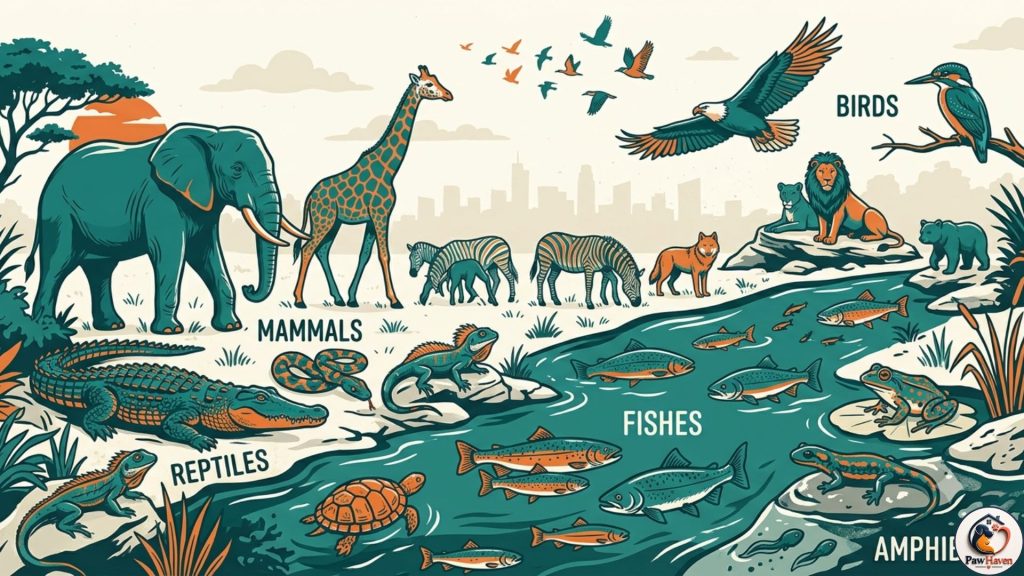
Mammals
Warm-blooded, fur-covered, live-birth (with a few odd exceptions). Mammals include everything from elephants and blue whales down to shrews that weigh less than a UK 10p coin. What unites them is nursing young with milk.
Birds
Over 10,000 known bird species, ranging from ostriches that can’t fly to Arctic terns that migrate approximately 70,000 kilometers round-trip every year. Birds are critical pollinators, seed dispersers, and pest controllers.
Reptiles
Cold-blooded, scaled, with an ancient evolutionary lineage. Crocodilians, snakes, lizards, turtles. Some are apex predators. Some, like the Komodo dragon, can detect prey scent from up to 9.5 kilometers away.
Amphibians
Frogs, toads, salamanders, caecilians. They’re among the most ecologically sensitive animals on the planet, absorbing pollutants directly through their skin. A drop in local amphibian populations is almost always an early warning of environmental degradation.
Fish
Approximately 33,000 known species live in freshwater ecosystems, marine environments, and everything in between. Fish form the base of enormous food webs and are a primary protein source for over 3 billion humans.
Insects and Other Invertebrates
This is where sheer biodiversity peaks. Insects alone account for roughly 80% of all known animal species. Pollinators, bees, butterflies, and some moths support around 75% of flowering plant species. Lose them, and global food production collapses within years.
Where Do Wild Animals Live?
No habitat is empty. Even the most extreme environments on Earth host species that have figured out how to survive there.
Forest Habitats
Temperate forests across Europe and North America host deer, wild boar, foxes, owls, and a dense layer of woodland wildlife. Ancient forests — those that haven’t been clear-cut in living memory — tend to have dramatically higher biodiversity than newer growth.
Grasslands and Savannas
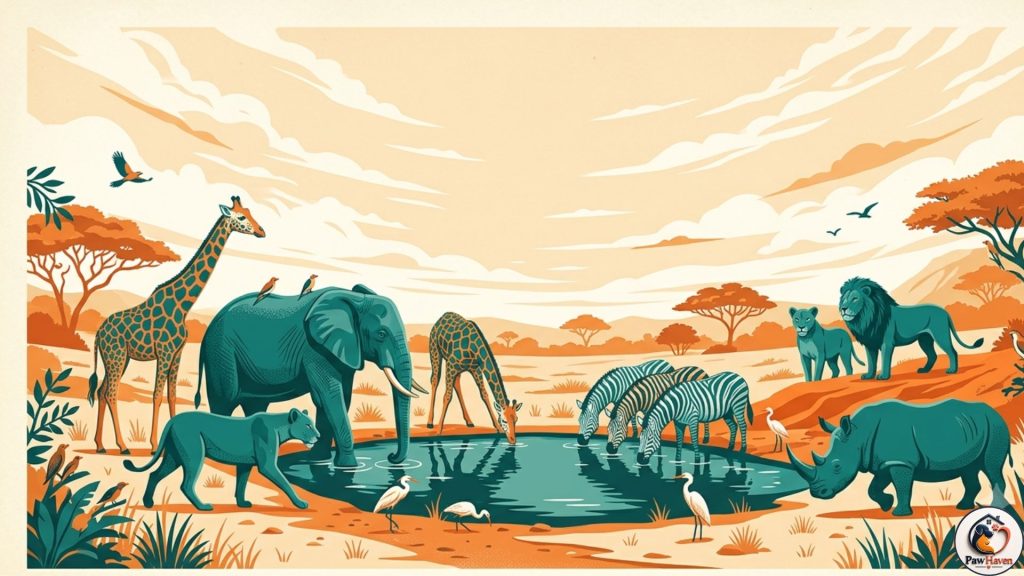
African savannas are the classic mental image: lions, zebras, wildebeest, hyenas in long grass under a wide sky. But North American prairies, South American pampas, and Central Asian steppes all support their own grassland ecosystems, many of which are critically underprotected.
Deserts
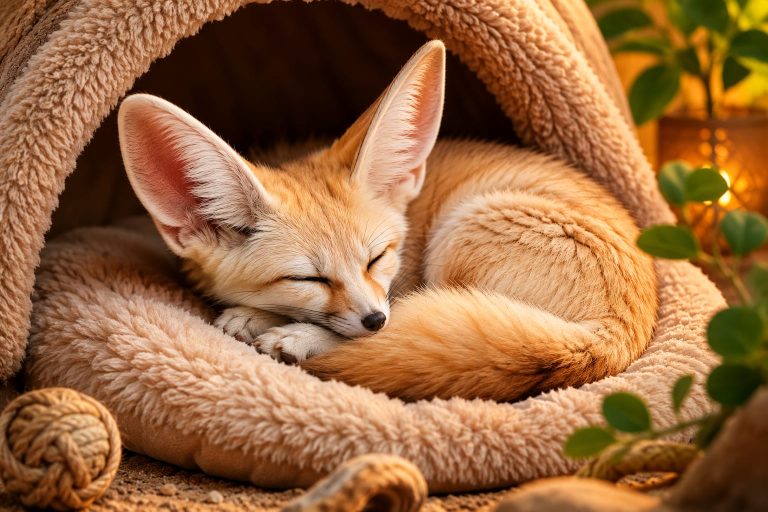
Deserts aren’t empty, they just look that way at noon. Fennec foxes, sidewinder rattlesnakes, meerkats, and hundreds of adapted insect species are active primarily at night, when temperatures drop to survivable levels.
Mountains
Mountain ecosystems often contain endemic species found nowhere else on Earth. Snow leopards, Andean condors, mountain gorillas — all restricted to specific altitude ranges where habitat conditions match their evolutionary needs.
Wetlands
Wetland habitats punch far above their weight for biodiversity. They support migratory birds during seasonal migration routes, host freshwater ecosystems including fish and amphibians, and filter enormous volumes of water naturally. Wetlands also store carbon at rates comparable to forests.
Oceans and Marine Ecosystems
Marine wildlife spans microscopic plankton to blue whales, stretching 30 meters. Coral reefs — sometimes called the rainforests of the sea — cover less than 1% of the ocean floor but support approximately 25% of all known marine species.
Polar Regions
Polar bears, emperor penguins, Arctic foxes, and harp seals. Species adapted to polar regions are often the first directly affected by climate change because the environmental changes there are happening roughly twice as fast as the global average.
Rainforests
Tropical rainforests contain an estimated 50% of all species on Earth despite covering only about 6% of the land surface. Most rainforest species are still undescribed by science — which means we’re losing species we haven’t even named yet.
What Do Wild Animals Eat?
Diet shapes everything about an animal: its body structure, behavior, habitat use, and role in the food chain.
Herbivores
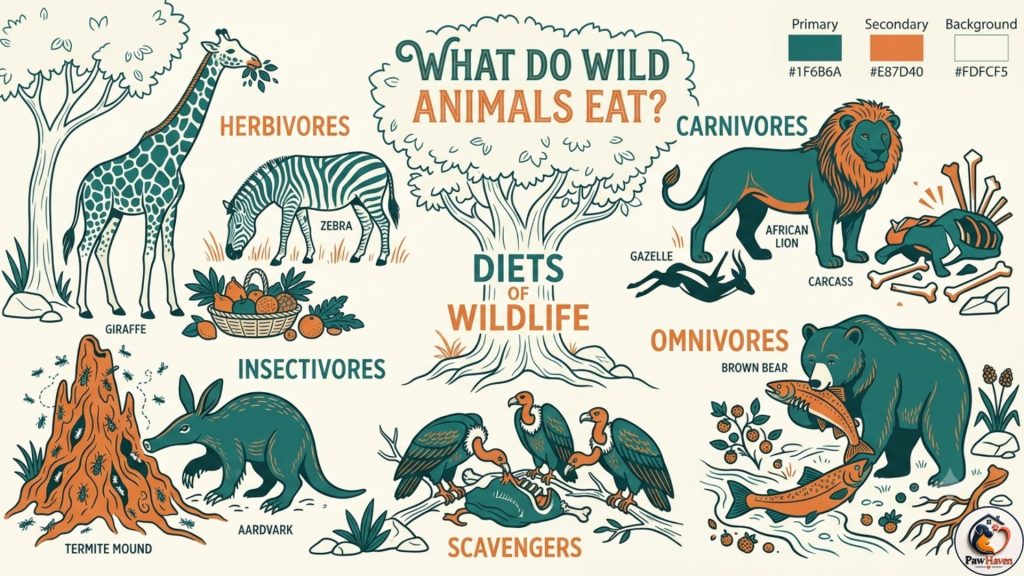
Plant-eaters. Elephants, rabbits, deer, and many birds. Herbivores typically spend a large portion of each day feeding because plant material is lower in caloric density than meat. An African elephant eats approximately 150 to 300 kilograms of vegetation per day.
Carnivores
Meat-eaters. Wolves, eagles, great white sharks, and most members of the cat family. Carnivores at the top of food webs are often called apex predator species with no natural predators themselves. Their population health directly controls prey species numbers.
Omnivores
Omnivores are often the most ecologically flexible species, able to shift diet based on seasonal availability. Raccoons, brown bears, most corvids (ravens, crows, jackdaws), and chimpanzees. Their flexibility makes them highly adaptable to habitat change, which is partly why they often thrive near human settlements.
Food Chains and Food Webs
A food chain is a linear sequence: grass → rabbit → fox → eagle. A food web is the realistic version: an interconnected network where most species eat multiple things and are eaten by multiple others. Webs are more resilient than chains, losing one species has cascading effects, but rarely single-handedly collapses the whole system. Unless it’s a keystone species.
Hunting and Feeding Adaptations
Cheetahs can reach 112 km/h but only sustain it for about 400 to 500 meters before overheating. Great white sharks can detect one drop of blood diluted in 10 billion drops of water. Archerfish spit water jets to knock insects off branches above the surface. Evolution is remarkably creative when survival is the selection pressure.
Amazing Adaptations That Help Wild Animals Survive
Adaptation is where wildlife gets genuinely astonishing.
Camouflage
Not just color matching. Stick insects mimic twigs down to the fake bud markings. Cuttlefish can change both color and skin texture in under a second. Leaf-tailed geckos in Madagascar have body outlines that match dead leaves, including fake “bite marks.”
Mimicry
Different from camouflage. Mimicry is copying another species. The harmless scarlet kingsnake mimics the color pattern of the venomous coral snake. Viceroy butterflies mimic monarchs. Orchid mantises look so convincingly like flowers that bees attempt to land on them.
Sharp Teeth and Claws
Structural tools shaped by millions of years of predator-prey relationships. A tiger’s canines can reach 7.6 centimeters long, long enough to pierce through bone.
Speed and Agility
The cheetah holds the land speed record, but the peregrine falcon reaches over 300 km/h in a hunting stoop — making it the fastest animal on Earth by a significant margin.
Migration
Arctic terns hold the migration distance record, approximately 70,000 km round-trip annually, equivalent to flying to the moon and back in a lifetime. Monarch butterflies navigate thousands of kilometers using Earth’s magnetic field combined with the position of the sun.
Hibernation
Not sleep. True hibernation involves a dramatic drop in body temperature, heart rate (from around 55 beats per minute to as low as 8 in some bears), and metabolic rate. Black bears in hibernation can go 100 days without eating, drinking, urinating, or defecating.
Defensive Mechanisms
Porcupines don’t throw quills, a persistent myth, but they do back into threats, so quills embed on contact. Bombardier beetles spray a boiling chemical mixture from their abdomen when threatened. Hagfish produce a sticky gel that clogs predators’ gills within seconds.
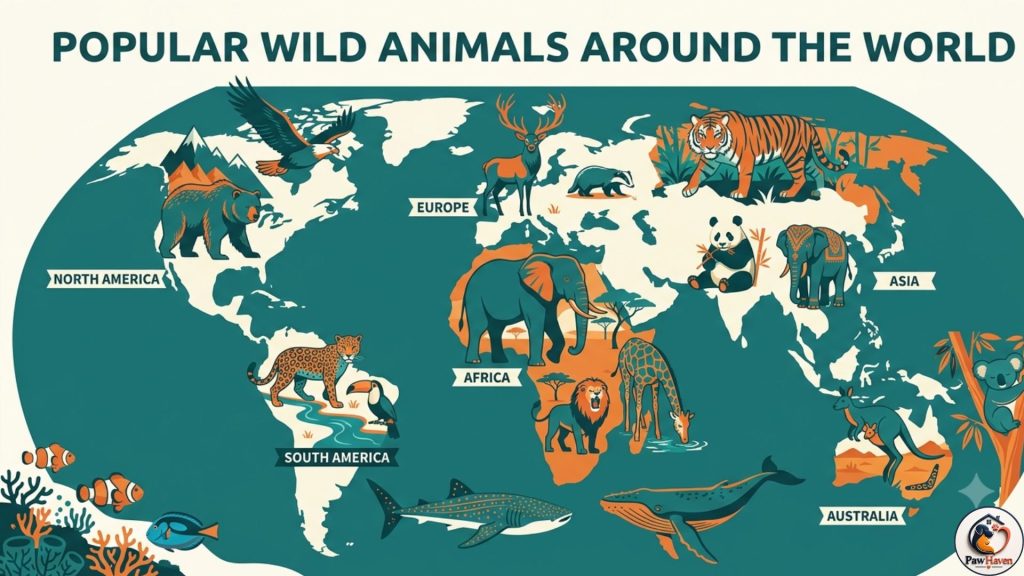
Popular Wild Animals Around the World
You’ve probably seen these in a wild animals book, documentary, or natural history museum. Here’s what makes each genuinely interesting beyond the basics.
Lions
The only truly social big cat. Pride structure gives lions a cooperative hunting advantage and females do approximately 90% of the hunting. Male lions look impressive; female lions actually run the operation.
Tigers
Solitary apex predators with territory ranges that can exceed 100 square kilometers for a single male. Fewer than 4,000 wild tigers remain globally, making them one of the most urgent conservation priorities.
Elephants
Demonstrate measurable grief behavior at the death of herd members, including touching the bones of deceased relatives with their trunks. Elephants also pass on knowledge across generations. Older matriarchs hold decades of information about water sources, migration routes, and predator patterns.
Wolves
Pack structure in wolves is far more cooperative and less rigidly hierarchical than popular culture suggests. Most packs are simply a family unit, two breeding adults and their offspring from multiple seasons.
Gorillas
Share approximately 98.3% of human DNA. Highly intelligent social animals that form long-term relationships, use basic tools, and show distinct individual personalities.
Wild Animals by Continent
| Continent | Iconic Species | Notable Ecosystem |
| Africa | Lion, elephant, giraffe, rhinoceros | Savanna, rainforest |
| Asia | Tiger, giant panda, orangutan, snow leopard | Tropical forest, mountain |
| North America | Grizzly bear, bald eagle, grey wolf, bison | Prairie, temperate forest |
| South America | Jaguar, anaconda, capybara, harpy eagle | Amazon rainforest, Pantanal |
| Europe | Brown bear, Eurasian lynx, red deer, osprey | Boreal and temperate forest |
| Australia | Kangaroo, koala, saltwater crocodile, platypus | Outback, reef |
| Antarctica | Emperor penguin, Weddell seal, leopard seal | Polar ice, sub-Antarctic ocean |
Threats Facing Wild Animals Today
This is where the picture gets hard to look at — and where it matters most to pay attention.
Habitat Loss
The single biggest driver of biodiversity loss. Agriculture, logging, and urban expansion fragment and destroy natural habitats faster than most species can adapt. Habitat fragmentation isolates populations, reduces genetic diversity, and cuts off wildlife corridors that species need to move between territories.
Climate Change
Shifting temperatures disrupt breeding seasons, migration timing, and food availability. Species adapted to specific temperature ranges are being pushed toward the poles or to higher altitudes. Some have nowhere left to go.
Pollution
Plastic pollution now reaches every marine environment on Earth, including the deepest ocean trenches. Seabirds, sea turtles, and marine mammals ingest plastic fragments, mistaking them for food. Chemical runoff from agriculture disrupts freshwater ecosystems and the amphibians and fish that depend on them.
Poaching
Distinct from illegal trade in that poaching often serves local subsistence needs as well as commercial markets. Solutions that ignore local economic realities rarely succeed long-term. Effective anti-poaching programs typically combine enforcement with community employment alternatives.
Human-Wildlife Conflict
Imagine a farming family whose livestock is killed by a leopard they’ve never seen and can’t afford to lose. Human-wildlife conflict is a direct consequence of habitat encroachment — as natural land shrinks, wild animals and human communities overlap increasingly. Coexistence programs that compensate farmers for losses and build non-lethal deterrents have shown real results.
How Can We Help Protect Wild Animals?
The honest answer is: most individual actions matter less than systemic change. But here’s the thing: systemic change requires enough individuals to create political and market pressure. Both are necessary.
Support Wildlife Conservation Organizations
Organizations like the WWF, Wildlife Conservation Society, African Wildlife Foundation, and hundreds of regional wildlife trusts do work that governments won’t fund sufficiently. Direct donations matter. So does choosing organizations with independently audited impact data over those with better branding.
Protect Natural Habitats
If you own land, even a garden, managing it for native fauna matters. Leaving patches of long grass, planting native flowering plants, and avoiding pesticides creates functional habitat within developed areas.
Reduce Plastic Waste
Not just personal plastic use but advocacy for producer responsibility legislation. Individual behavior change at scale helps, but redesigning packaging systems at the source removes billions of plastic items before they reach consumers.
Practice Responsible Tourism
Wildlife tourism funds conservation in many regions. Ethical wildlife photography and observation means: staying on designated paths, not approaching or feeding animals, not purchasing wildlife products as souvenirs, and choosing operators with legitimate conservation credentials.
Avoid Products Made from Wildlife
Tortoiseshell, ivory, shark fin, and traditional medicines containing tiger or rhino material all fuel the illegal wildlife trade. Demand drives supply. Eliminating personal demand matters.
Educate Others About Conservation
Not just children. Adults who engage with wildlife content, even a wild animal printable for a school project, a documentary, or a well-written article, shift how they vote, spend, and talk about these issues. Conservation awareness creates the public pressure that changes legislation.
Small Everyday Actions That Make a Difference
Buying organic reduces pesticide load in agricultural land adjacent to wild habitats. Choosing sustainably sourced seafood reduces pressure on overfished marine ecosystems. Keeping domestic cats indoors at night (cats kill an estimated 55 million birds per year in the UK alone) is one of the highest-impact things a pet owner can do for local wildlife.
Wild Animals vs Domestic Animals
This comparison comes up constantly. Here it is laid out clearly.
Comparison Table
| Characteristic | Wild Animals | Domestic Animals |
| Domestication history | None | 5,000 to 15,000+ years |
| Habitat | Natural ecosystems | Human-controlled environments |
| Diet | Self-sourced in the wild | Provided by humans |
| Behavior | Instinct-driven, survival-focused | Partially modified by selective breeding |
| Human interaction | Typically avoidant or aggressive | Adapted for coexistence |
| Survival without humans | Yes, naturally | Reduced — many domestic breeds couldn’t survive independently |
| Legal to keep as pets | Usually restricted or prohibited | Generally yes |
The survival skills gap is significant. A domestic dog’s ancestor was a wolf, but a modern Labrador Retriever wouldn’t last long independently in a wild ecosystem. Domestication traded self-sufficiency for coexistence.
Interesting Facts About Wild Animals
A few facts that tend to genuinely surprise people:
Fastest: Peregrine falcon at over 300 km/h in a dive. On land, the cheetah at 112 km/h, but only for short sprints.
Largest: Blue whale — up to 30 meters long and 200 tonnes. The largest animal ever known to have existed, including all dinosaurs.
Smallest: Etruscan shrew (Suncus etruscus) is the smallest mammal by mass at approximately 1.8 grams. The Paedophryne amauensis frog is the smallest known vertebrate at around 7.7mm long.
Smartest: Chimpanzees, dolphins, elephants, crows, and octopuses all demonstrate problem-solving abilities that challenge straightforward definitions of intelligence. Crows can solve multi-step puzzles and manufacture tools from raw materials — a capability once thought uniquely human.
Longest-living: The Greenland shark has a confirmed lifespan of at least 272 years, with some estimates suggesting up to 500 years. The ocean quahog clam has reached 507 years.
Loudest: The sperm whale produces clicks at up to 230 decibels — the loudest sound made by any animal. For reference, a jet engine at close range is around 140 decibels.
Most dangerous (to humans): Mosquitoes, by a significant margin. They transmit diseases responsible for over 700,000 human deaths per year. Large predators like sharks kill fewer than 10 people annually worldwide.
Frequently Asked Questions
What are wild animals?
Wild animals are non-domesticated species that live independently in natural habitats, sourcing their own food and raising young without human assistance. They span all major animal groups: mammals, birds, reptiles, amphibians, fish, and invertebrates.
What is the difference between wild and domestic animals?
Domestic animals have been selectively bred alongside humans for thousands of years, developing behavioral and physiological traits suited for coexistence. Wild animals retain instincts shaped purely by survival in natural ecosystems. The difference isn’t just behavioral, it’s genetic.
Which wild animal is the strongest?
By muscle strength relative to body size, the dung beetle can pull over 1,141 times its own body weight. For absolute raw strength, elephants move loads exceeding 9,000 kilograms. For bite force, the saltwater crocodile records the highest at approximately 3,700 pounds per square inch.
Which wild animal is the fastest?
The peregrine falcon at 300+ km/h in a dive is the fastest animal on Earth. On land, the cheetah at 112 km/h holds the record. In water, the sailfish reaches approximately 110 km/h.
Can wild animals be kept as pets?
In most countries, keeping wild animals as pets is legally restricted or outright prohibited, and for good reason. Even species that seem manageable when young become dangerous and distressed as adults. Wild animals kept as pets frequently develop severe psychological problems from the inability to express natural behaviors.
Why are wild animals becoming endangered?
Habitat loss is the primary driver, followed by climate change, illegal wildlife trade, pollution, and invasive species. Most endangered species face several of these pressures simultaneously, which is why single-issue conservation approaches rarely succeed.
How do wild animals survive in harsh environments?
Through millions of years of evolutionary adaptation, physiological (thick fur, specialized kidneys, heat-exchange systems), behavioral (hibernation, migration, nocturnal activity), and structural (body shape, coloring, sensory adaptations).
How can children help protect wild animals?
Children can genuinely contribute through citizen science projects like the RSPB’s Big Garden Birdwatch, reducing plastic use, choosing sustainably sourced school supplies, and engaging with a wild animals book or printable resource that builds conservation awareness early. Even planting native flowering plants in a garden directly supports pollinators.
Recommended Articles:
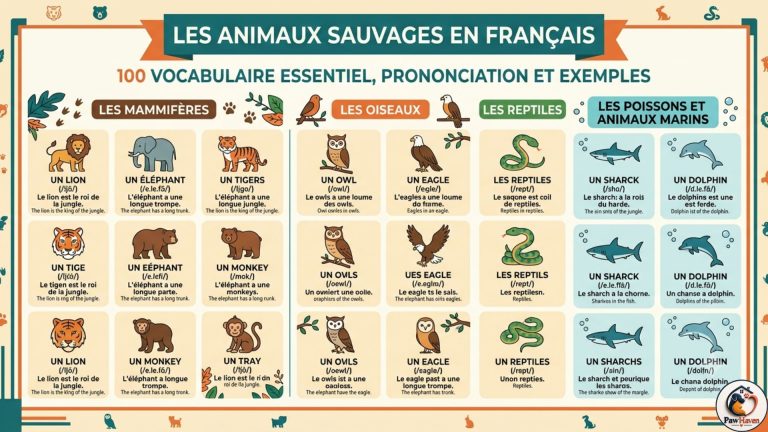
Wild animals in French are provided with 100 essential vocabulary words