Critical Care for Rabbits: Complete Feeding, Recovery, and Homemade Care Guide
A rabbit that skips two meals in a row is not being picky. It is in danger. Rabbits have a digestive system built around constant motion, and once that motion stops, a cascade of problems starts fast. That is the moment critical care rabbit feeding stops being optional and becomes the thing standing between your pet and a much worse outcome.
This guide is written for anyone facing that moment, whether you have raised rabbits for fifteen years or brought your first bunny home last month. You will learn what critical care actually means, when to start it, how to feed it correctly, and what a realistic recovery timeline looks like.
Quick Answer
Critical care rabbit food is a syringe-fed, high-fiber recovery formula made for rabbits that have stopped eating due to illness, surgery, or gut slowdown. Oxbow’s Critical Care is the most widely used product, typically mixed with warm water into a thick, pudding-like consistency and fed every four to six hours until the rabbit resumes eating hay and pellets on its own.
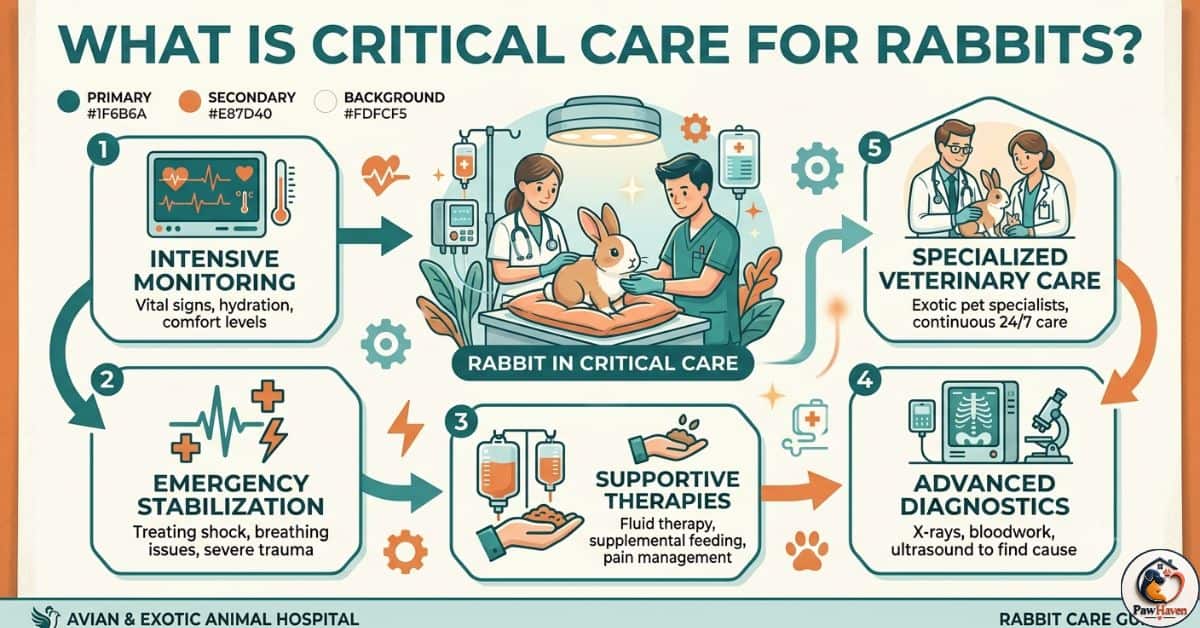
What Is Critical Care for Rabbits?
Rabbits are hindgut fermenters. Their gut depends on a steady stream of fiber to keep bacteria populations balanced and material moving through the intestines. Stop the flow of food, and gut motility slows or halts entirely, a condition commonly called GI stasis.
Understanding rabbit digestive health
The healthy rabbit gut runs almost continuously. Food goes in, hay keeps things moving, and droppings come out at a steady pace all day. Interrupt that cycle for even twelve hours, and gas can build up, appetite drops further, and the rabbit enters a downward spiral that gets harder to reverse the longer it continues.
Why rabbits cannot go long without food
Unlike cats or dogs, rabbits cannot simply “wait out” a lack of appetite. A rabbit that has not eaten for 12 to 24 hours needs veterinary attention because the gut environment begins to shift toward harmful bacteria almost immediately.
Common situations that require critical care feeding
GI stasis, dental disease that makes chewing painful, post-surgery recovery, general illness or injury, and simple appetite loss after a stressful event all call for the same response: assisted feeding until the rabbit eats on its own again.
When Should You Start Critical Care Feeding?
Watch for a hunched posture, teeth grinding from pain, reduced or absent droppings, a bloated abdomen, or a rabbit that turns away from hay entirely. Any one of these on its own is worth a same-day vet call.
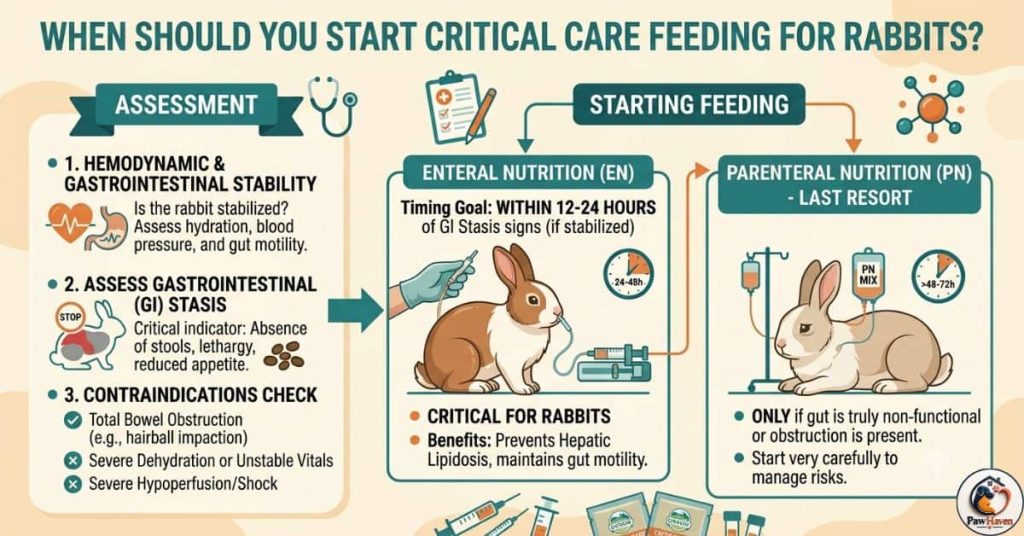
Featured Snippet: How do you know if a rabbit needs critical care?
A rabbit needs critical-care feeding when it refuses food for more than 8 to 12 hours, produces few or no fecal pellets, or shows signs of pain, such as a hunched back and grinding teeth. A rabbit-savvy veterinarian should confirm the diagnosis before home feeding begins, since force-feeding a rabbit with a full gut blockage can make things worse rather than better.
Types of Critical Care Food for Rabbits
Oxbow Critical Care is the industry standard, sold in Original Apple Banana and Anise flavors as a powder you mix with warm water. It is formulated specifically for herbivores, meaning it leans heavily on timothy hay fiber rather than the protein and fat ratios found in recovery diets made for dogs or cats.
| Feature | Oxbow Critical Care | Herbivore vs Omnivore Formula |
| Base ingredient | Timothy hay fiber | Herbivore: hay-based / Omnivore: meat or fish-based |
| Consistency | Powder mixed with water | Varies; some are ready to feed |
| Best for | Rabbits, guinea pigs, chinchillas | Never use omnivore formulas on rabbits |
| Storage | Sealed, cool, dry place after opening | Refrigerate mixed portions; discard after 24 hours |
Store the unopened powder somewhere cool and dry, and once mixed, keep leftovers refrigerated and use them within a day.
How to Feed Critical Care to a Rabbit
You will need the formula, a coffee grinder if you are using pellets instead of powder, a 1 or 3 milliliter feeding syringe, a towel, and warm water.
Mix the powder with warm water to a thick gravy or yogurt-like consistency; thinner mixtures increase the risk of aspiration. Wrap your rabbit gently in a towel, sometimes called a burrito wrap, so it feels secure and cannot back away mid-feeding.
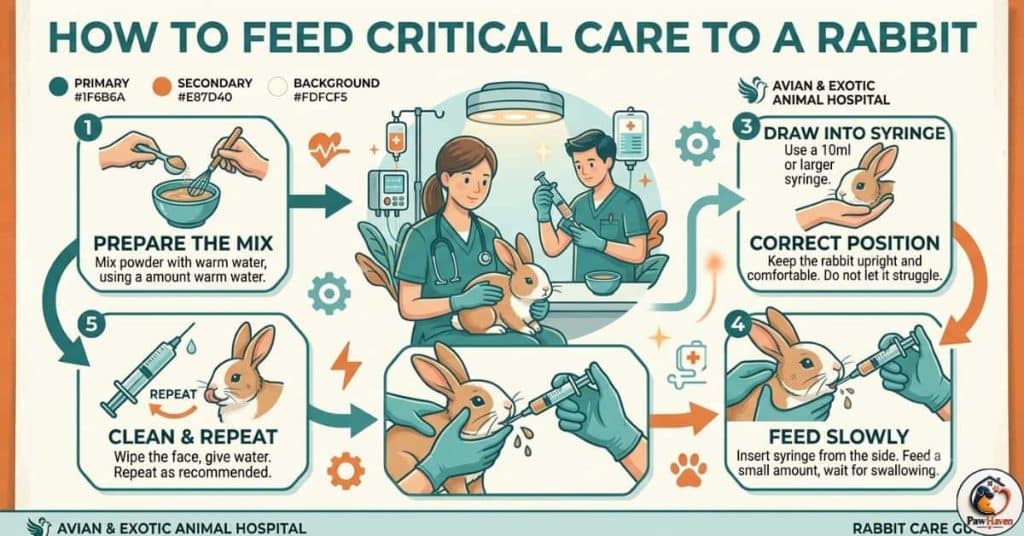
Most adult rabbits need roughly 15 to 20 milliliters per kilogram of body weight per feeding, split across four to six sessions a day. Insert the syringe gently along the side of the mouth behind the front teeth, and give the rabbit time to swallow between small pushes rather than forcing a steady stream.
Featured Snippet: How much critical care should a rabbit eat per day?
Most adult rabbits need 15 to 20 milliliters per kilogram of body weight per day, divided into four to six small feedings, though your veterinarian may adjust the amount based on your rabbit’s specific condition and weight.
Homemade Critical Care for Rabbits
In my experience, homemade mixes work best as a bridge, not a replacement, when commercial powder is not immediately available. A basic version blends finely ground timothy hay pellets with warm water and a small amount of mashed banana for palatability, though it lacks the balanced fiber ratio Oxbow engineers into its formula.
Never include lettuce, dairy, bread, or anything high in sugar or starch, since these disrupt the gut flora a recovering rabbit desperately needs to stabilize. Homemade mixtures spoil quickly and should be prepared fresh for each feeding rather than stored for later use.
Supporting Recovery Beyond Feeding
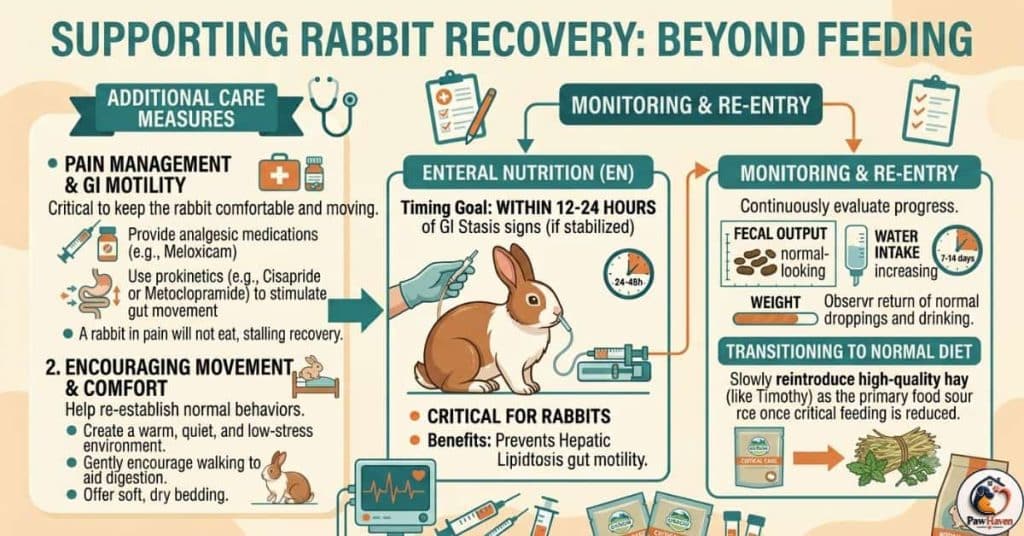
Hydration matters as much as calories. Offer water regularly and consider a vet-approved electrolyte solution if dehydration is suspected. Keep the environment quiet, dim, and free of other pets, since stress alone can stall a rabbit’s return to voluntary eating.
Track droppings daily. A steady increase in fecal pellet size and number is the clearest sign your rabbit is turning the corner, often more reliable than appetite alone.
Common Problems During Critical Care Feeding
A rabbit refusing the syringe often responds better to a slower approach and a different feeding angle. Food coming back out usually means the mixture is too thin or the rabbit’s head is tilted incorrectly. Diarrhea after feeding, unlike normal soft cecotropes, is a red flag requiring an immediate call to your vet, not a wait-and-see approach.
Critical Care Recovery Timeline
The first 24 hours focus purely on stabilizing appetite and hydration. By days two and three, most rabbits on the right treatment plan begin nibbling hay voluntarily between syringe sessions. A full week of steady eating and normal droppings is generally the benchmark before fully weaning off assisted feeding.
Preventing Future Digestive Emergencies
Unlimited fresh timothy hay, constant access to water, and routine dental checks catch most problems before they become emergencies. Keep a small rabbit first aid kit on hand with a spare feeding syringe, unopened Critical Care powder, and your vet’s after-hours contact number.
Frequently Asked Questions
What is Critical Care for rabbits?
It is a syringe-fed recovery formula made from timothy hay fiber, designed for rabbits that have stopped eating due to illness or surgery.
How much Critical Care should I syringe feed my rabbit?
Roughly 15 to 20 milliliters per kilogram of body weight daily, split into four to six feedings, adjusted by your veterinarian.
Can I make homemade Critical Care for rabbits?
Yes, as a short-term bridge, using ground timothy hay pellets and warm water, but it should not replace a commercial formula long term.
How often should I feed a rabbit with GI stasis?
Every four to six hours until the rabbit resumes eating hay and pellets on its own.
How long can a rabbit survive without eating?
Serious risk begins at 12 to 24 hours without food, making prompt veterinary care essential.
Is Critical Care safe for baby rabbits?
Only under veterinary guidance, since young rabbits have different nutritional needs and dosing requirements.
Recommended Articles:
Best Foods for Pet Birds: The Complete Feeding Guide (2026)
Vet Approved Dog Treats & Supplements
Wild animals in French are provided with 100 essential vocabulary words
Dog Treat Packaging Ideas: 10 Ways to Nail Pet Food Packaging in 2026